
Making healthy choices starts with learning to handle strong feelings. In this lesson, your student learned:
- Their brain is still growing. The prefrontal cortex (PFC) helps us think clearly and logically, allowing us to make healthy choices—but it will keep developing for several more years.
- Stress can take over. In a stressful or dangerous situation, the amygdala may set off the Fight, Flight, or Freeze response. This makes it hard to think, so your student may act impulsively.
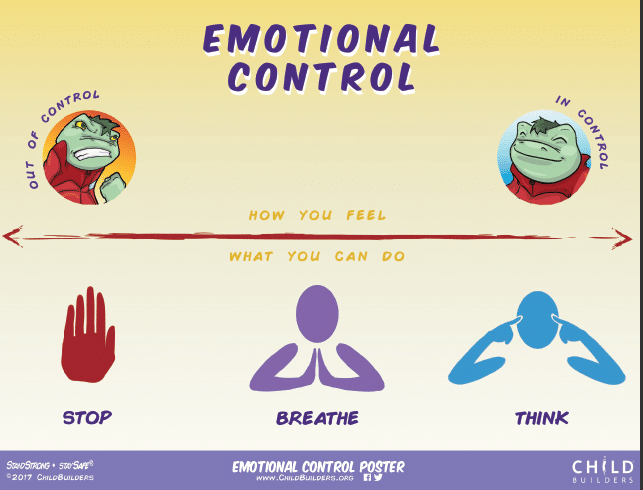
- Stop, Breathe, Think. Noticing and managing strong feelings helps your student pause before they act and make safer choices.
Have you ever asked your student, “What were you thinking?” Sometimes the honest answer is that they weren’t thinking. They were reacting to strong feelings.
Practice At Home
- Try Different Calming Strategies. Your student learned several calming strategies in class. Ask about their favorite strategy and share your own!
- Deep Breaths: Taking deep breaths is a great way to help your body and brain calm down. Breathe in for 3 seconds, hold for 2 seconds, then breathe out for 5 seconds. Rest and repeat.
- 5-Finger Breathing: Hold one hand out with your fingers spread apart. Use the pointer finger of your other hand to slowly trace around each finger. Breathe in as you trace up a finger, and breathe out as
you trace down. Keep going until you have traced all five fingers. - 5-4-3-2-1: Sit calmly and look around the space you’re in. Slowly name 5 things you can see, 4 things you can hear, 3 things that you are touching or that are touching you, 2 things you can smell, and 1 thing you can taste.
- Share other healthy calming strategies with your student, such as drawing, listening to music, taking a walk, watching a happy movie, or talking to a trusted friend or adult.
- Name Your Safe Adults. An important part of the Stand Strong • Stay Safe lessons is helping your student name trusted adults who can help them. Having several safe adults to turn to helps children grow up
emotionally healthy. These adults can help when a situation feels too stressful or confusing to handle alone.- Ask your student to name 2 adults in your family and 2 adults at school or in the community. These should be people your student feels they could talk to about anything if they ever needed help. Then,
make sure your student knows how to contact their safe adults if something unsafe happens.
- Ask your student to name 2 adults in your family and 2 adults at school or in the community. These should be people your student feels they could talk to about anything if they ever needed help. Then,
- Review the Stand Strong Superpowers (see graphic) with your student. These are good concepts to keep in mind throughout your safety conversations together.
- We keep our relationships safe by paying attention to our emotions and the emotions of the people around us.
- We are all responsible for managing our emotions. Using stress management strategies can really be helpful in preventing escalation and hurtful reactions.
- Managing emotions makes it possible for us to be assertive and stand up for each other’s right to be safe, to make responsible choices, and to get help when we need it.
Stay Connected
Strong feelings are easier to handle when you don’t feel like you’re alone. Try these simple ways to connect as a family to talk about feelings.
- Calm Together. Choose 1 or 2 of your student’s favorite calming strategies and practice them together at a time when your student is already calm. Practicing when things are calm makes it easier to use these skills when emotions run high.
- Share Your Story. Tell your student about a time you felt upset, scared, or angry. Describe how your body reacted and what you did to calm down. Then ask: What does your body feel like when you’re stressed?
- Make a Cool Down Spot. Choose a quiet corner of your house. Place a comfy chair and items that help you stay calm: a pillow, drawing supplies, headphones and music, a favorite book, and a squish ball or fidget. Anyone can use it when they need a break.