
What We Learned
Today, your student learned how to handle conflict in a healthy way. We may not like it, but conflict arises from time to time in every relationship. Many people associate conflict with violence, but in healthy relationships, people use strategies to resolve differences in a safe way.
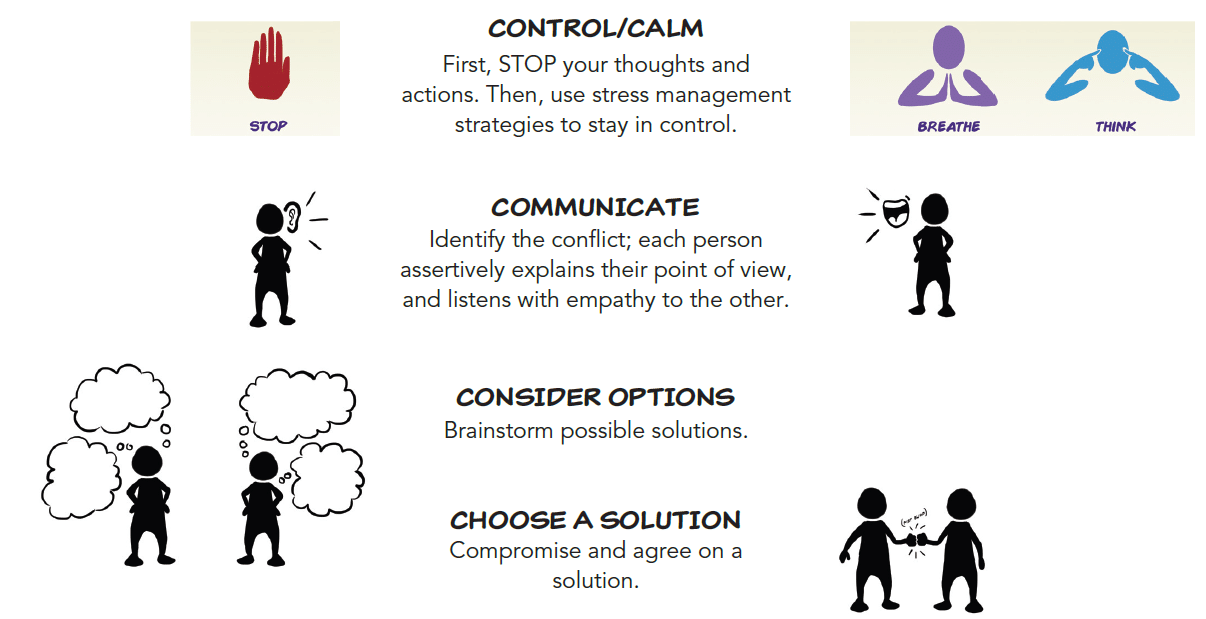
As adults, it can be hard to model healthy conflict resolution if we’ve never experienced it ourselves. The Stand Strong • Stay Safe program teaches simple steps for resolving conflict safely so parents and children can learn together. The steps are called the 4 C’s of Handling Conflict.
Practice At Home
It’s great to learn some new tools for handling conflict, but without a lot of practice and determination, it becomes easy to slip back into habits that don’t help when conflict arises.
-
- Ask your student to explain the steps and reflect on what they learned in class.
- Role-play the scenarios below. Decide who will play each person, then act out how to solve the conflict using the 4 C’s. To make it more fun, switch roles for each scenario!
- Scenario 1: Sammy is supposed to finish homework before playing video games. Sammy’s friends are already online, and Sammy feels frustrated. Sammy says, “You never let me do anything fun!” Sammy’s parent also gets frustrated and says, “You’re always arguing with me. Just do what I told you!”
- Scenario 2: Noah and Zoe are working on a project together. Zoe takes over and picks all the ideas without asking Noah. Noah gets angry and says, “You always have to be in charge! I’m not doing this anymore!”
- Scenario 3: Lena’s teacher asks her to stop talking while the class is working. Lena says, “I wasn’t even talking!” The teacher says, “I’ve asked you three times. You’re being disrespectful.” Lena gets defensive and refuses to do what the teacher asked.
- How did it go? After completing each role play, discuss the following questions. Let your student answer each question first, then share your thoughts. Feel free to dig deeper into any question, or come up with your own.
- How did you feel playing the role?
- Was it hard to use the 4 C’s? Why or why not?
- Do you think the 4 C’s worked to resolve the conflict effectively? If so, what worked best? If not, what would you do differently?
- Do you think the 4 C’s will work in real life situations? Why or why not?
Stay Connected
Conflict is a normal part of life. How you handle it at home and how you talk about it with your student helps them understand what healthy conflict can look like.
- Model the 4 C’s. When you and your student disagree, talk through the steps out loud: “I need a minute to calm down” or “Let’s brainstorm some options.” Your student learns the most from watching you.
- Be a Coach, Not a Referee. If your student is in a conflict with a friend or a sibling, gently remind them to try using the 4 C’s. Start by asking which step in the 4 C’s they are on, and what is next.
- Celebrate the Wins. When your student tells you how they used the 4 C’s in a real-life conflict, be sure to let them know how impressed you are! Ask them how they feel about resolving the conflict in a healthy way.